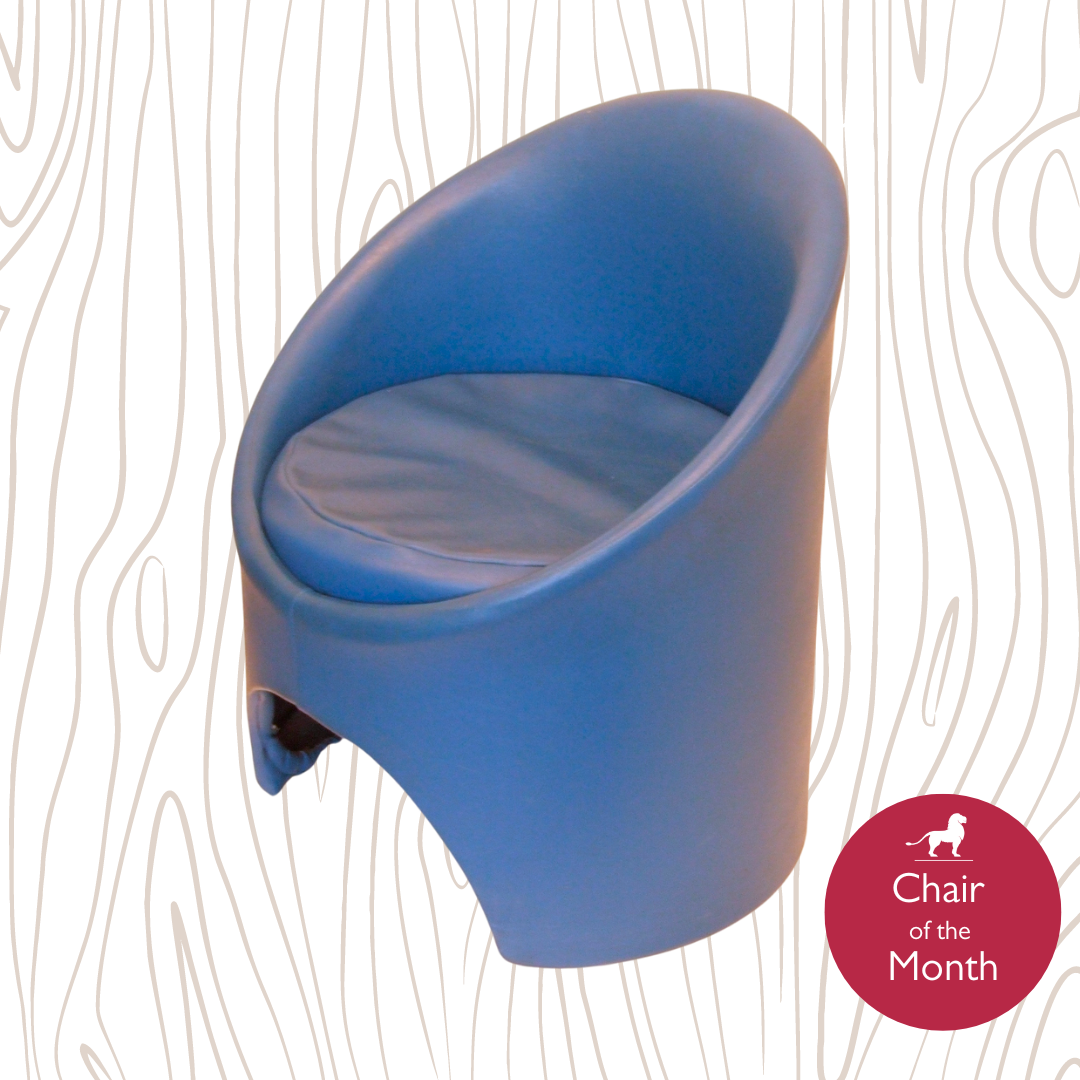
Does this bring back memories of the Swinging Sixties?
Chair of the Month for February is this wonderful GoGo chair, designed by Robert Bennett for Evans of High Wycombe. Evans have been making bespoke sofas and chairs since 1958, and the GoGo reflects their innovative and experimental designs of the time which used new materials and styles, such as this blue vinyl, bucket-shaped chair.
Robert Bennett was a local furniture designer whose career also saw him designing pieces for another local company, Gomme Ltd, as part of their renowned G-Plan range.
You can see this chair in our temporary exhibition ‘Our Place’ until 10 March 2024.Chair of the Month is a partnership between Wycombe Museum www.wycombemuseum.org and the Regional Furniture Society https://regionalfurnituresociety.org
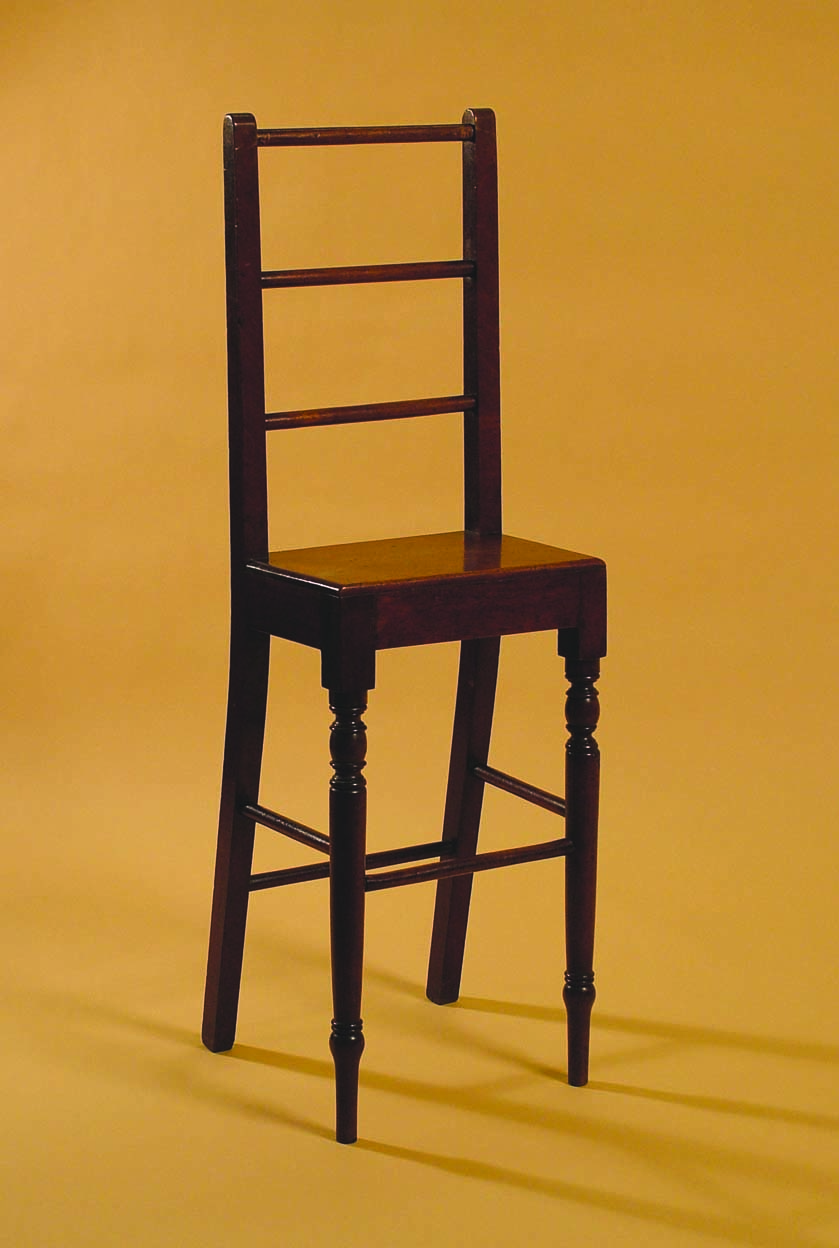
Chair of the Month for January is for anyone who has made a New Year’s Resolution to have better posture!
Made in about 1790, it is a type of child’s chair known as a deportment chair or correction chair. The high, narrow, shiny seat meant that there was no slouching– or the child would slide off!
You can see this chair in Wycombe Museum’s permanent galleries.
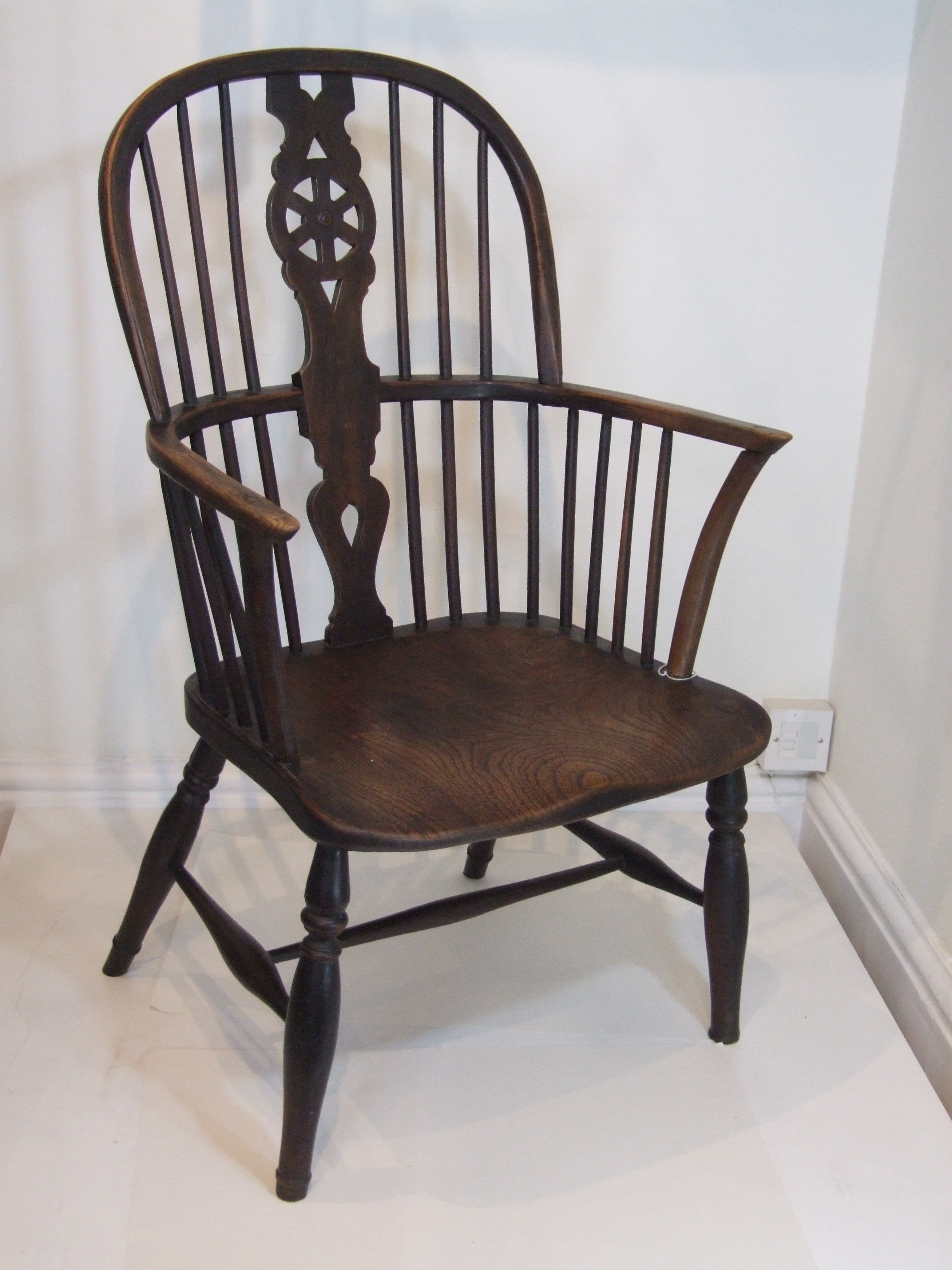
Chair of the month for December is this Wheelback Windsor armchair, made in the High Wycombe area, about 1800-1830. Made from various local woods, including cherry wood, elm, ash, beech and yew.
By the early 1800s, Windsor chair making had become centred on High Wycombe. Wheelback Windsor chairs like this one were made in large numbers. The various timbers have been carefully chosen for the chair part that suits it best. For example, cherry and yew woods are used decoratively on the front legs and in the centre of the wheel in the back. Elm is used for the seat because it was available in wide planks and has an attractive grain pattern. The bow (hoop) is made from ash which bends well without splitting. The back legs are made from beech, which was cheaper and more readily available than cherry wood.
This chair is on display in Wycombe Museum’s ‘Our Place Exhibition’ until 10 March 2024. Information about Wycombe Museum’s exhibitions can be found here Exhibitions | Wycombe Museum Official Site
Chair of the Month is a partnership between Wycombe Museum wycombemuseum.org.uk and the Regional Furniture Society regional furnituresociety.org
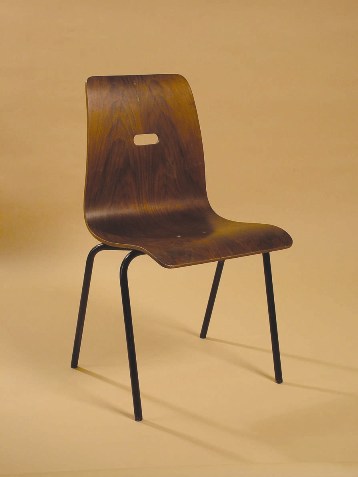
November’s chair of the month is this ‘Q – Stack’ chair, designed by Robin Day of High Wycombe in about 1953 and manufactured by Hille in London.
In the 1950s, new ways of constructing chairs were made possible by new materials such as plastic, plywood and tubular steel. This chair uses plywood, with tubular steel legs held on by two bolts. It has a hand grip in the back, so that it can be easily carried. Unlike traditional chairs, several of these chairs can be stacked on top of each other when not being used. It was designed as a low-cost space-saver for meeting places, cafes, halls, and homes.
It is currently on display in Wycombe Museum’s Chair Galleries.
Chair of the Month is a partnership between Wycombe Museum wycombemuseum.org.uk and the Regional Furniture Society regional furnituresociety.org
Members may be interested in the following BIFMO-FHS online course on Zoom:
1 November: 5 pm – 7.30 pm (GMT) and 1 pm – 3.30 pm (EDT) 8, 15, 22 and 29 November: 5 pm – 7.30 pm (GMT) and 12 noon – 2.30 pm (EST) Please note that for the first week, the start time for US ticketholders on the East Coast will be four hours behind the UK. Thereafter, the time difference will be five hours.
Join us online for a couple of hours every Wednesday throughout November, when curators and historians will consider the development of styles in Britain, from the seventeenth to the mid-twentieth century, by examining the creative process involved in making furniture. Speakers will look at how designs were devised and the impact of collaboration between different disciplines on the way concepts and ideas were realised and translated into objects.
Guided by specialist speakers, the course will look at a wide range of examples of design and craftsmanship from almost 500 years of furniture making in Britain; from the influence of print designs on makers in the early seventeenth century to the mass-produced furniture of Charles and Ray Eames in the twentieth.
Here’s an overview of the course programme:
Session 1 – 1st November
Early print sources and their influence on furniture makers
Speakers: Nick Humphrey, Catherine Doucette, Dr Amy Lim.
Session 2 – 8th November
Furniture makers interpreting design in the 18th century
Speakers: Katherine Hardwick, Annabelle Westman, Dr Megan Aldrich.
Session 3 – 15th November
Furniture makers, Designers and Architects in 18th century Britain
Speakers: Dr John Cross, Professor Jeremy Howard, Dr Kerry Bristol.
Session 4 – 22nd November
Stretching the imagination: furniture making in the 19th century
Speakers: Ellinor Gray, Dr Diana Davis, Clarissa Ward.
Session 5 – 29th November
Innovation and modernity: the role of the designer in the 20th century
Speakers: William Lorimer, Matthew Winterbottom, Professor Pat Kirkham.
Tickets may be bought for individual sessions or for the entire course, but you will benefit from a discount if all 5 sessions are bought together. Don’t worry if you cannot attend the sessions live because they will be recorded and links to the recording will be sent to ticketholders.
For further information and to purchase tickets please click here to travel straight to the Eventbrite page. FHS members and ECD members will receive a discount on all tickets. If you have any questions, please contact Ann Davies at bifmo@furniturehistorysociety.org.
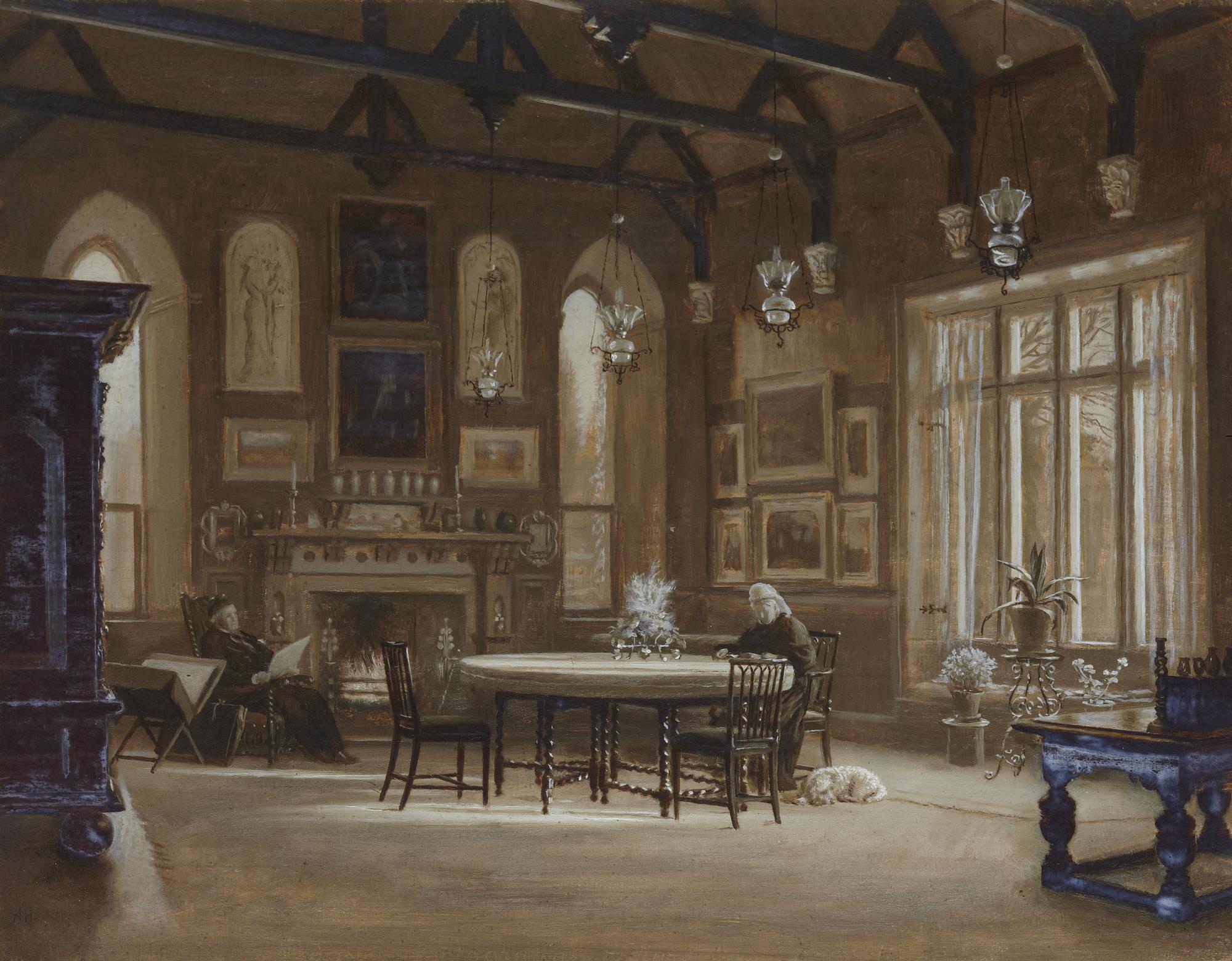
Banqueting Hall at Penkill, Ayrshire, William Bell Scott and Alice Boyd, oil on board, by Arthur Hughes, 1892
On Friday 1 December, the National Museum of Scotland in Edinburgh is hosting an all-day seminar on The Scottish Interior. Ten speakers will address the Scottishness – or otherwise – of Scottish interiors from the sixteenth century to the present day, examining craftsmanship, patronage, collecting, and identity. The event is free and lunch will be provided (courtesy of the Paul Mellon Centre) but booking is essential. Details can be found here.
Chair of the Month for October is the Wycombe Pitt Chair, a Windsor armchair made by John Pitt in the 1740s. It is made from beech with walnut arm-bow, fruitwood legs and elm seat. The maker of this early Windsor chair was John Pitt, wheel maker and Windsor chair maker. He lived in the hamlet of Upton-cum-Chalvey, which is now part of Slough. The chair is painted with the coat of arms of the City of Bath. Upton-Cum-Chalvey was on the main road from London to Bath.
The Wycombe Pitt chair was bought for the museum with the help of The Art Fund, The V&A Purchase Fund and The Beecroft Bequest.
An article about John Pitt was published by the Regional Furniture Society in 2005. You can read it here.
You can see this chair in Wycombe Museum’s ‘Our Place Exhibition’, until 10 March 2024. Information about Wycombe Museum’s exhibitions can be found here Exhibitions | Wycombe Museum Official Site
Chair of the Month is a partnership between Wycombe Museum wycombemuseum.org.uk and the Regional Furniture Society regional furnituresociety.org
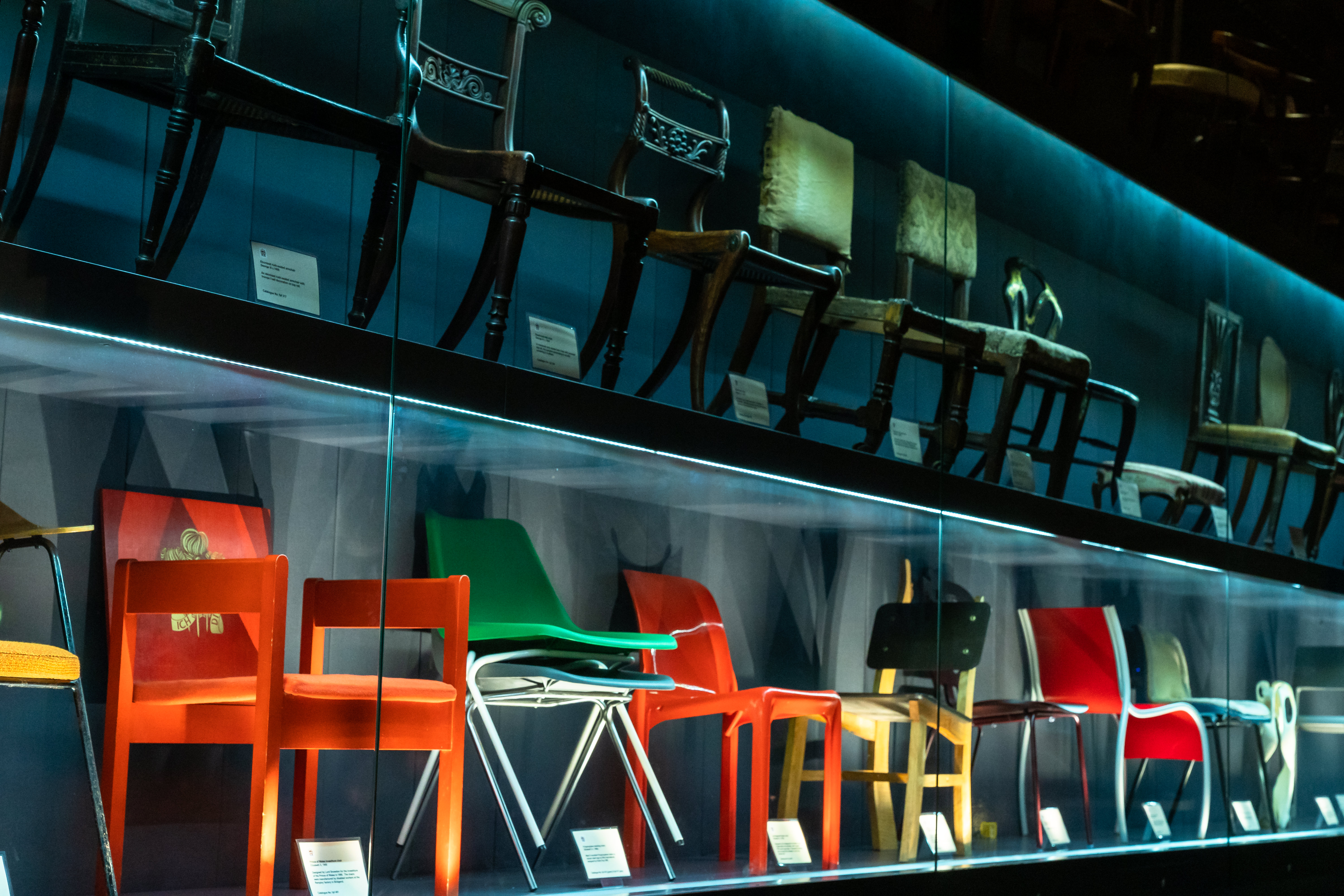
The Furniture Makers’ Company is pleased to announce the launch of a new online catalogue of the Frederick Parker chair collection. This unique collection of 191 British chairs dating from the 1670s to 2015 has now been researched, assessed and digitally photographed, to complete the first comprehensive catalogue of the collection. The chairs are fully described in a clear and accessible format suitable for students, historians and anyone interested in furniture history.
The collection was formed mainly in the early 20th century by furniture makers Frederick Parker & Sons, to provide a resource of antique styles suitable for reproduction. As the demand for reproduction furniture declined in the mid-century, the collection became redundant and in 1997 it was saved from disposal by the formation of a trust, the Frederick Parker Foundation, which was able to raise the funds to purchase a significant number of the chairs. The collection is now owned by the Furniture Makers and is on long-term loan to London Metropolitan University, with many of the chairs on display and the rest in controlled storage, accessible for study. Further chairs, especially of the late 20th century, have been added to show a coherent progression of English chairmaking from the 17th century to the present day.
The chair collection is complemented by the Frederick Parker and Parker Knoll Archive, also owned by the Furniture Makers and on loan to the university, providing a fascinating record of 150 years of furniture production.
We encourage visitors, especially students in design, making and upholstery, to make use of this unique learning resource. The online chair catalogue now enables people to study the collection remotely and we hope it will inspire further research and new directions in design and manufacture.
The chair collection catalogued can be accessed here.
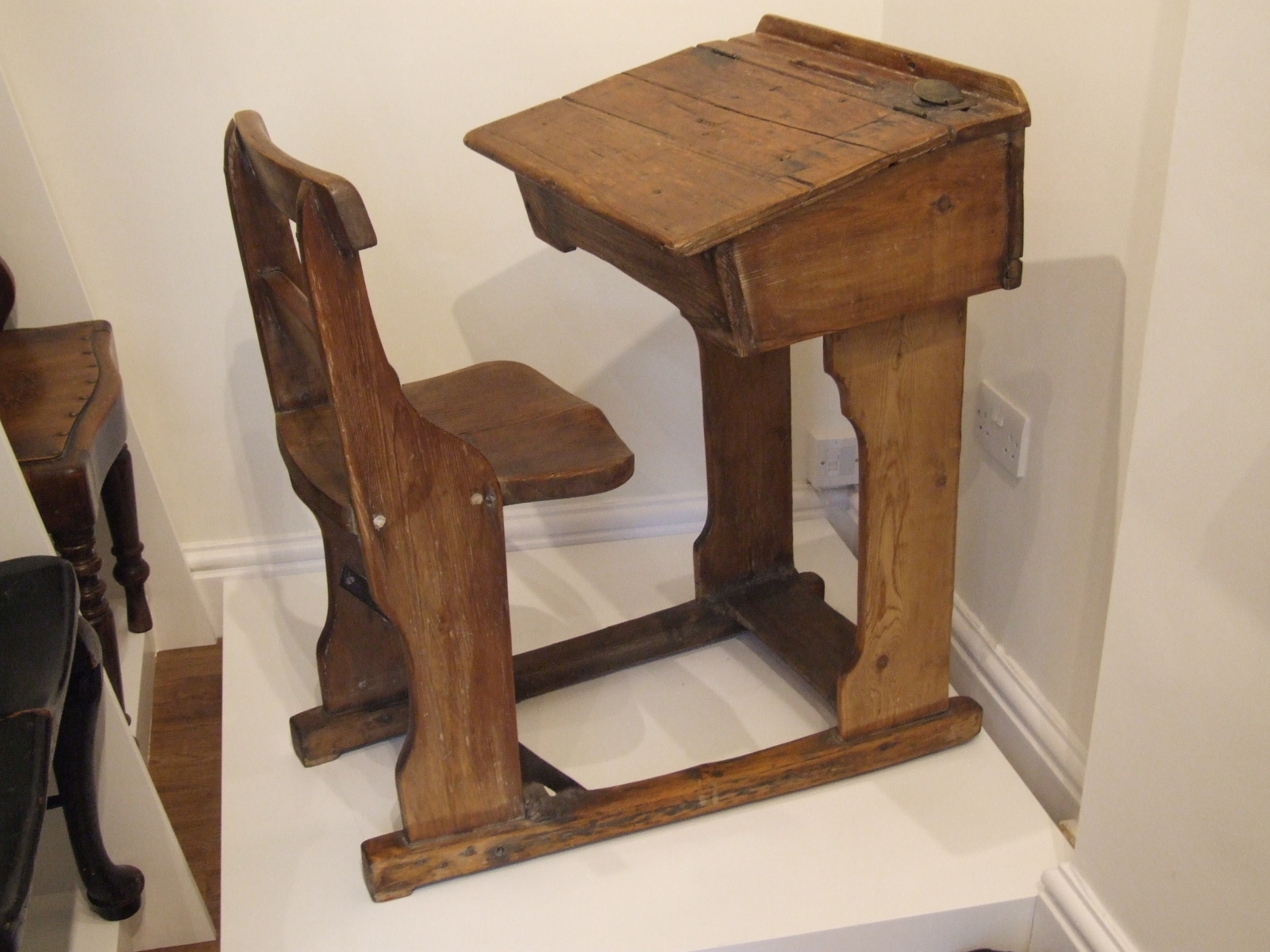
September is back-to-school month! Combined school desk and chair, made in 1909. Unlike most of the artefacts at Wycombe Museum, it wasn’t made locally. It was made by Geo. M. Hammer and Co, of The Strand in London.
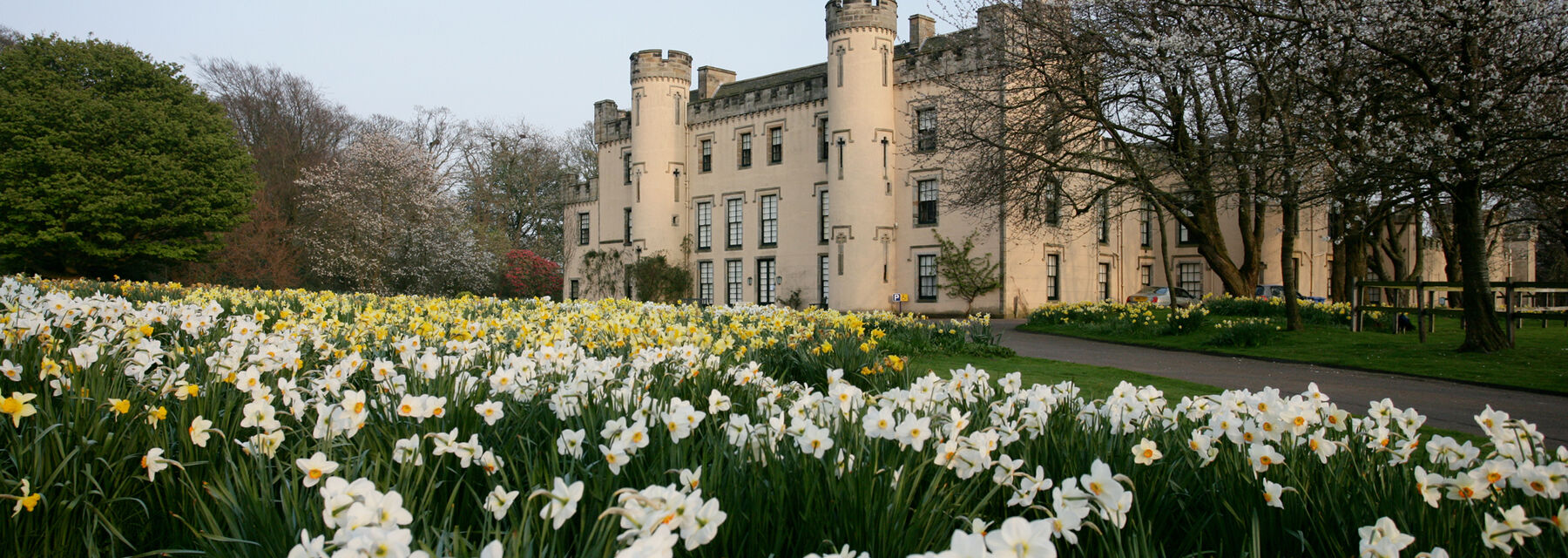
House of The Binns; image: National Trust for Scotland
A family home founded by Thomas Dalyell about 1612, an Edinburgh merchant who made his fortune at the court of King James VI and I in London. Presented to the National Trust for Scotland in 1947 by Eleanor (Nora) Dalyell, mother of the late MP Tam Dalyell. The family retain the right to live there. Much altered and extended in the 18th and 19th century, the house contains an eclectic mix of furniture and works of art from all eras, including political and military memorabilia, associated with its more colourful owners, including General Tam Dalyell who escaped from the Tower of London and fought alongside Peter the Great’s father in Russia.
Kathleen Dalyell and Helen Knox, NTS Manager will be our hosts whilst David Jones has kindly agreed to guide us through the furniture.
Coffee will be provided on arrival. At the end of the visit a nearby venue for lunch will be suggested (not included in the fee). If you are a member of the National Trust or Scottish National Trust, please remember your membership card. If numbers exceed 12, we may need to progress in two parties.
Linlithgow is easily reached from Glasgow or Edinburgh by train. Members with cars will pick up travellers from the station.
If you wish to join the visit, a cheque for £10 a head, payable to Regional Furniture Society should be posted to : RFS Events Organiser, 2 Grove Cottages, Sutherland Road London W4 2QS together with a list of members and friends attending and a mobile telephone number. Alternatively, make a bank transfer to the RFS sort code 30-94-81 a/c 00882432 quoting reference: ‘Binns’, followed by an email to the events organiser, confirming the names of those attending, mobile number and the date of the bank transfer. Closing date for applications is Monday September 4th.





You must be logged in to post a comment.