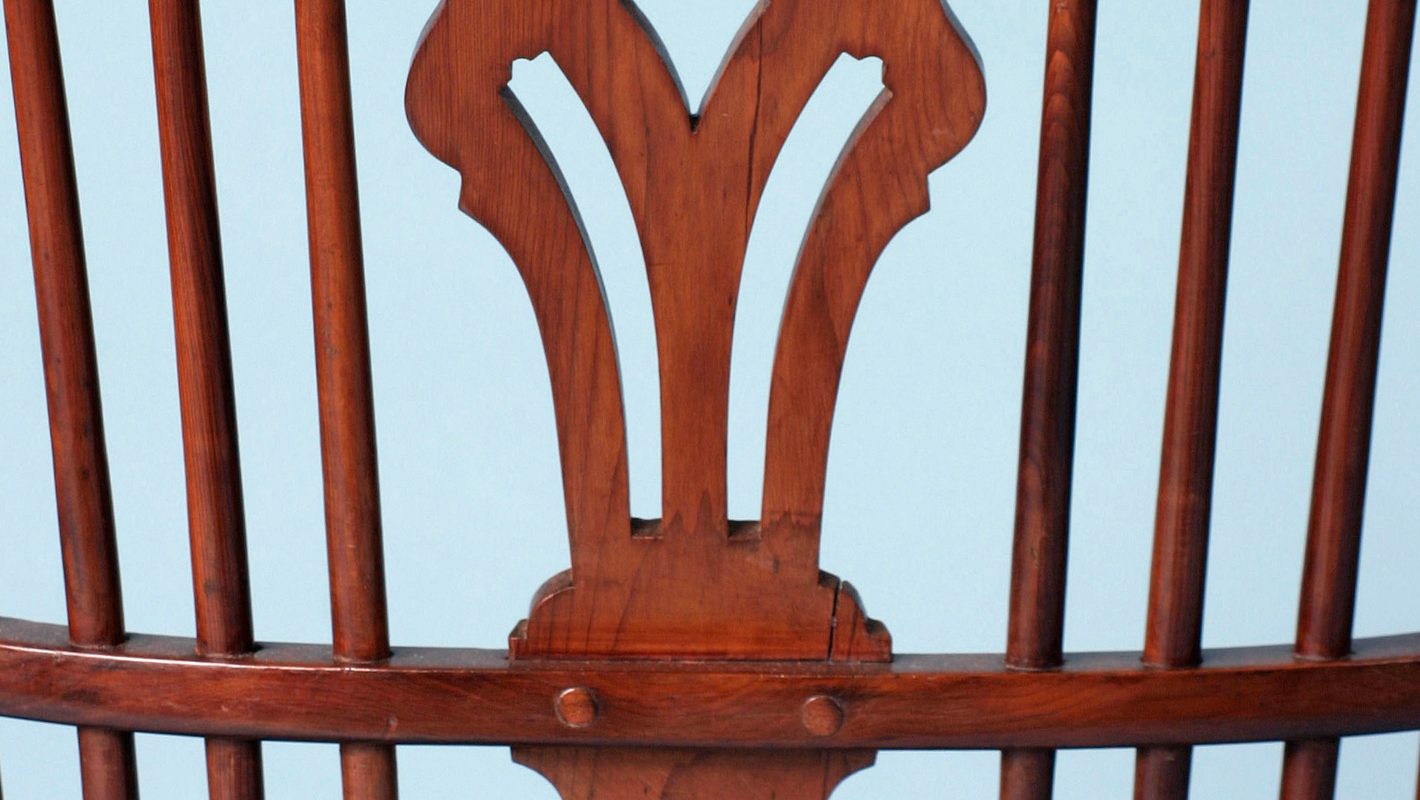
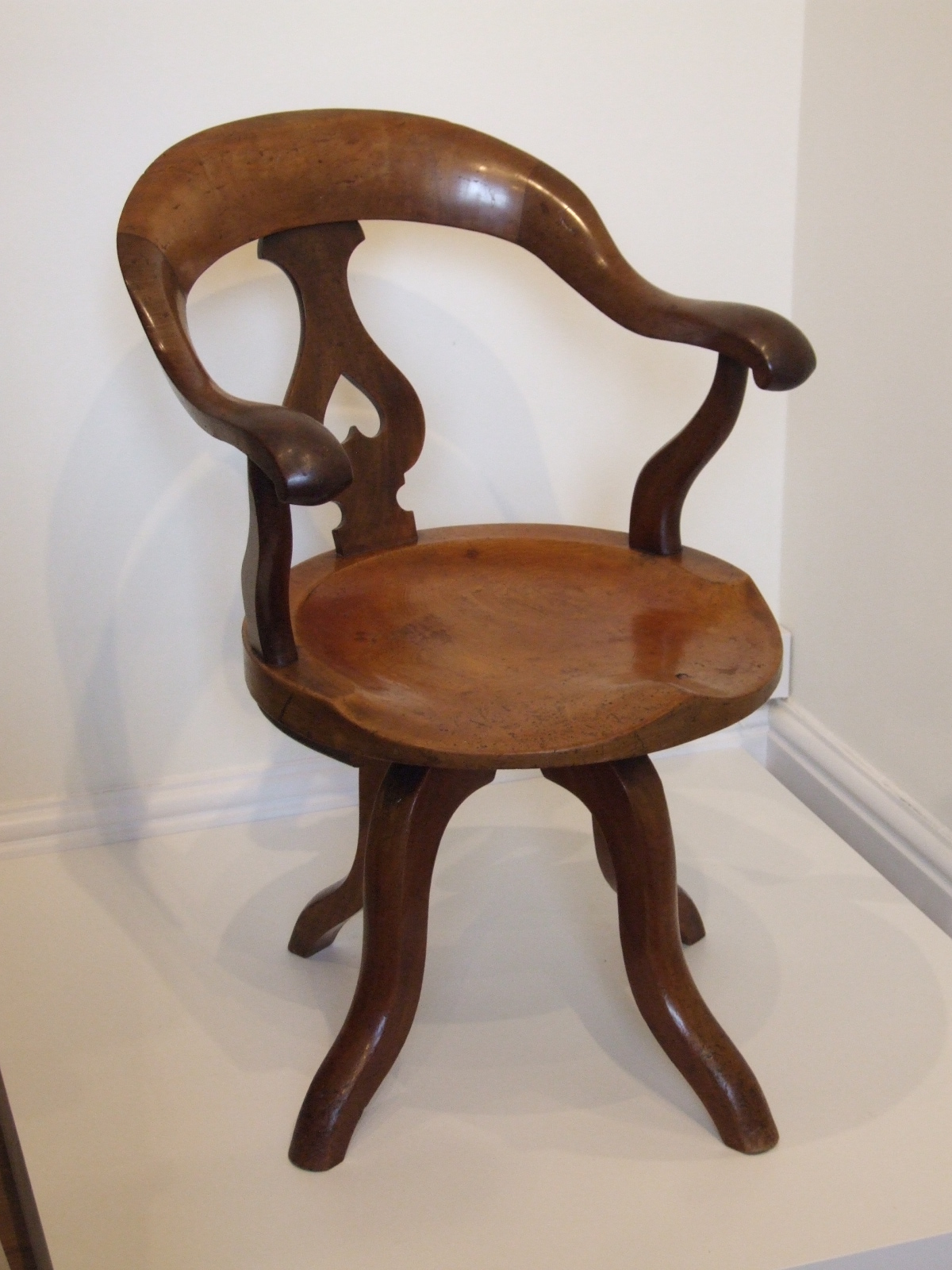
Our Chair of the Month for February is this office chair with an inverted heart pierced into the back. It probably dates from around 1900 and has a venetian red mahogany style finish. It can be viewed in the chair galleries at Wycombe Museum.
Chair of the Month is a partnership between Wycombe Museum and the Regional Furniture Society.
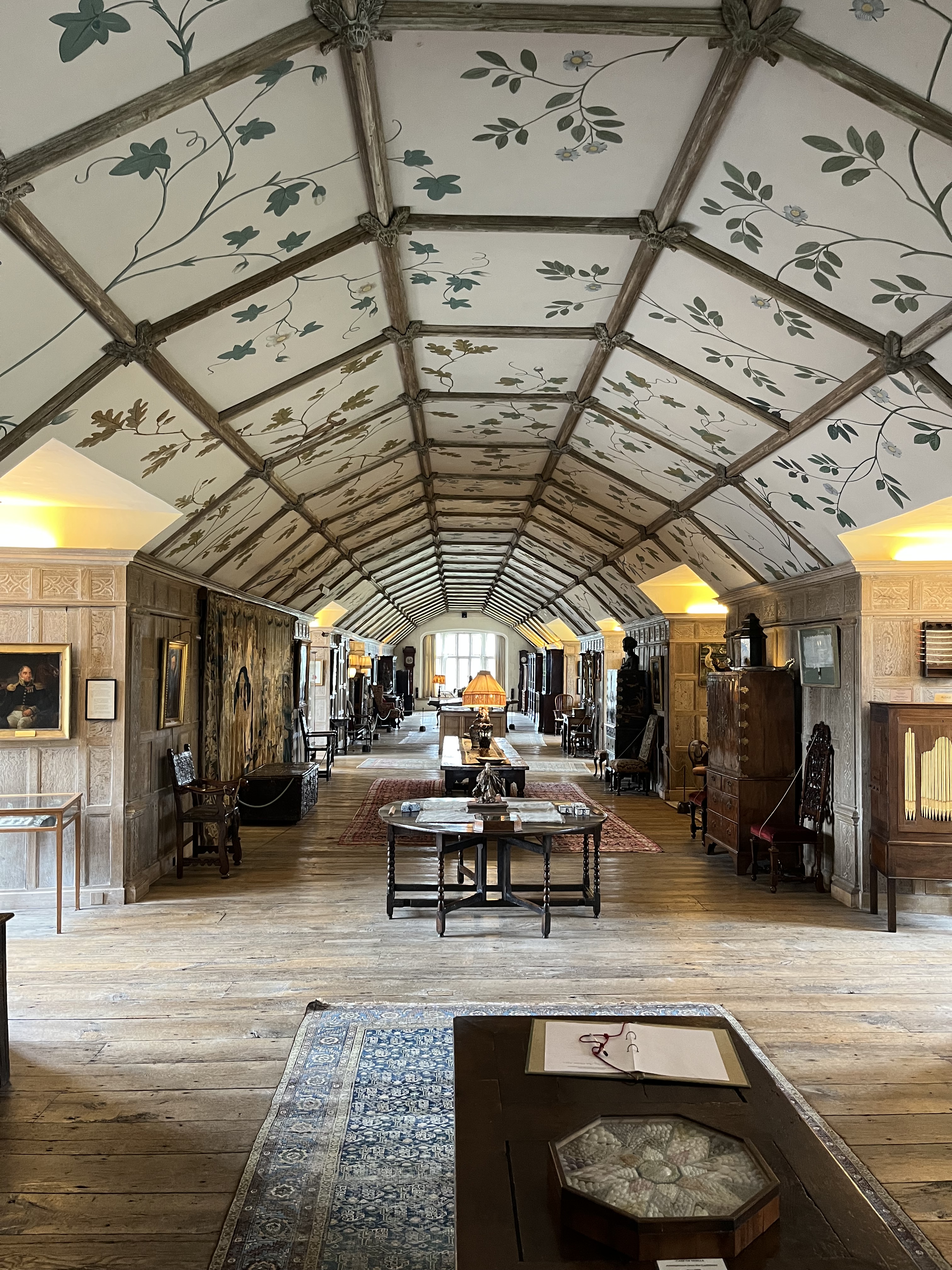
We will start on Tuesday afternoon at Gregynog Hall near Newtown, a fine nineteenth-century mansion with an exceptional early seventeenth-century carved oak room surviving from the earlier house. This was the twentieth-century home of the Davies sisters who were early collectors of impressionist and post-impressionist paintings, all now in the National Museum of Wales. Twentieth-century collections in the house are furniture by Peter Waals and Brynmawr. Gregynog is the home of the famous private press of the same name. In the early evening, we visit Cwm Weeg, Newtown, a fifteenth-century cruck farmhouse with late twentieth-century extensions and large garden including a grotto.
On Wednesday morning we meet at Brithdir Hall, Berriew, a sixteenth-century timber-framed house with later Georgian alterations and an interesting collection of early pictures and furniture. Lunch will be at the Horseshoes Inn, Berriew. In the afternoon we will have a tour of Vaynor Park, Berriew, a seventeenth-century brick-built mansion substantially embellished c.1840 by Thomas Penson. It has been home to the current owner’s family since the mid-eighteenth century and its collections include fine twentieth-century pictures. This is followed by an early evening visit to Llanerchydol Hall, near Welshpool, an early nineteenth-century neo-gothic house by one of the Reptons, containing some of the original mirrors and pier tables.
On Thursday we visit Walcot Hall, Bishops Castle, a brick mansion by William Chambers for 1st Lord Clive, with substantial twentieth-century alterations. Our final visit will be to the Judge’s Lodgings, Presteigne, with early nineteenth-century purpose-built court rooms and cells by Edward Haycock and original furnishings.
A two-course lunch on Wednesday and Thursday, a two-course supper on Wednesday and tea and cake on all three days is included.
Numbers will be limited to 30
Cost: £225
Please complete the Booking Form and send to RFS Events Team at events.rfs@gmail.com by 27 March 2026. You will be sent payment details in the following week.
The visit will start at 10:00, with a welcome and coffee at the Wycombe Museum. We will have a talk by curator Catherine Grigg on chair making in the area followed by an update on the chair conservation work and development of the new store, the Chair Discovery Centre. This is a major project to which the RFS has contributed grant funding. There will then be time for a self-led visit round the galleries before lunch of sandwiches and cake.
In the afternoon we will walk to the Chair Discovery Centre, a 5-minute walk down the hill.
The visit will finish at 4:00pm.
For members arriving by train, the museum is a few minutes’ walk from the station. There is limited on-site parking at the museum, with disabled parking available. Metered road-side parking and car parks are available within a five-minute walk.
Numbers will be limited to 20
Cost: £40.00
Please complete the Booking Form and send to RFS Events Team at events.rfs@gmail.com by 26 February. You will be sent payment details in the following week.
Museum location and contact:
Wycombe Museum Priory Avenue High Wycombe HP13 6PX
January’s Chair of the Month is this Art Nouveau-style carved armchair with a pink velvet-covered upholstered seat.
It was made by John R Clarke of High Wycombe in about 1905, and carved by his brother-in law Edmund Hutchinson. At the time this chair was made, several Wycombe makers were experimenting with fashionable styles like this, as well as continuing to make traditional Wycombe chairs like Windsors.
This chair is part of the latest batch recently added to our online chair database. See more at the link below!
December make us think of being cosy and comfortable at home beside the fire, and this month’s chair of the month would be perfect for that!
These chairs were first made by G-Plan in about 1965 and the company named them ‘The World’s Most Comfortable Chair’. Made between 1965 and 1980, they have featured in James Bond films as the villain’s chair.
This particular chair was used by a family in Hounslow, and still has the green velour cover that the family used to protect it.
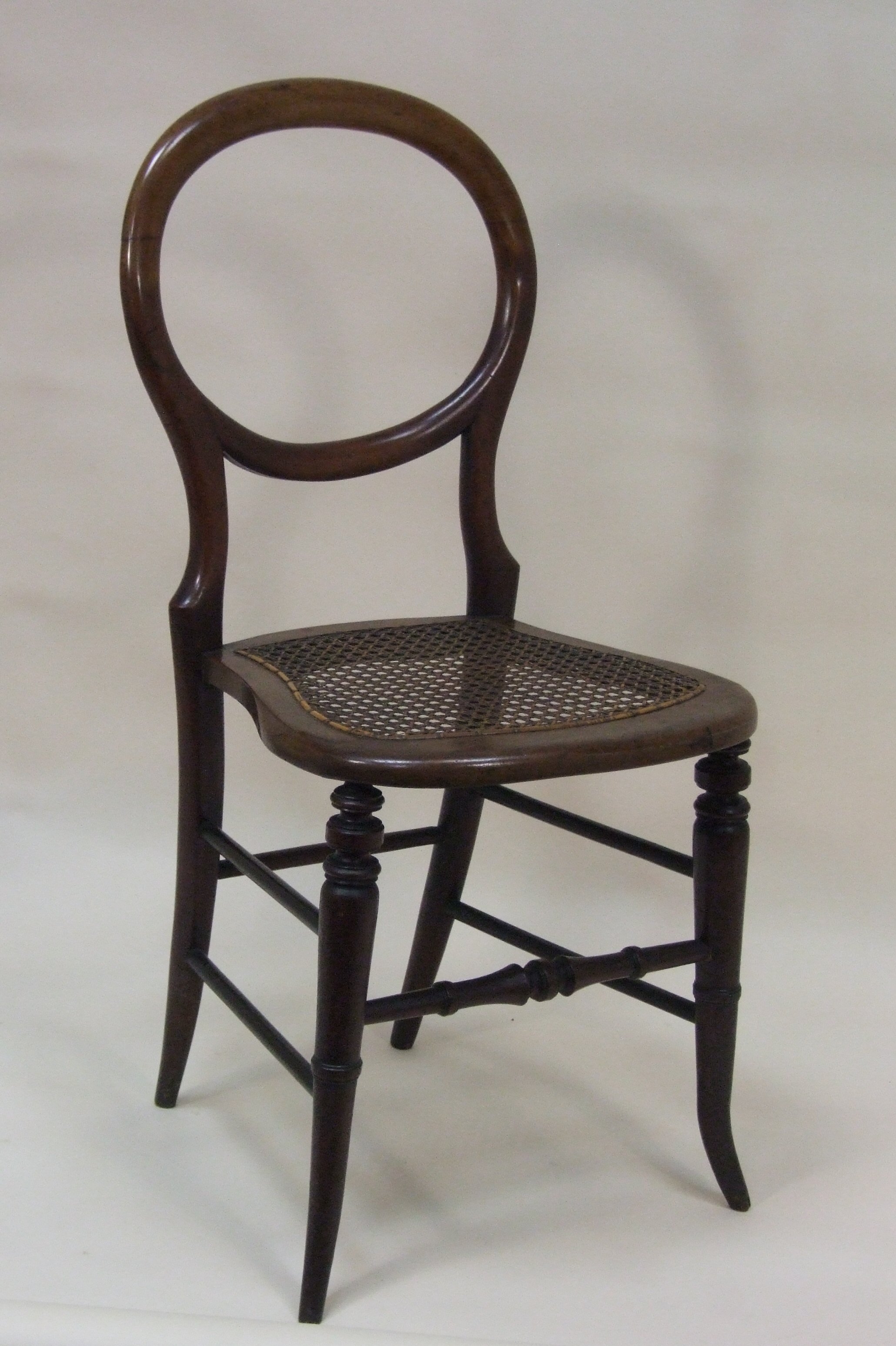
November’s Chair of the Month is a trouser press chair.
Made in London in the 1920s by VC Bond and Sons, it was given the name Vee Cee Bee, after the company name. Like bedroom chairs made in High Wycombe it has a caned seat. It also has a press in the back, used to take the creases out of trousers.
Members may be interested in the following event at The National Museum of Scotland:
Join us for a special film screening and panel discussion to hear about the Ash Rise project. Learn more about Scotland’s native ash tree, the challenges of ash die-back and how the material is celebrated in contemporary furniture making.
Inspired by the ongoing touring exhibition Ash Rise, presented by the Scottish Furniture Makers Association, the documentary film of the same name tells the story of this beautiful tree, its historic and contemporary brilliance as a material and the challenges of ash die-back.
The film screening will be followed by a panel discussion featuring the film’s creative director, Tom Addy, alongside contemporary furniture maker, Helena Robson, and the Chief Forester for Scotland, Dr Helen McKay. The discussion will be chaired by Stephen Jackson, Senior Curator of Furniture and Woodwork.
This auditorium event will be followed by an opportunity to meet the makers and see examples of ash woodwork and furniture up close in the Events Space on Level 2, from 15:30–16:30. The Events Space will also be open to visitors from 13:00 until the event begins at 14:00.
Our Chair of the Month for October is this mid 20th century dining chair by Owen Haines’ factory in High Wycombe.
Underneath the seat are the initials ‘OH’, handwritten in ink. It was previous catalogued as being possibly made by Owen Harris. However, we’ve been doing some work across our chair collection, and we think ‘Owen Harris’ was a mistake and that this chair was in fact made by Owen Haines. Other chairs in our collection by Owen Haines have the same handwritten initials.
We know that Owen Haines’s factory was in Jubilee Road and Green Street from about 1907 until the 1960s. There is no record of an Owen Harris making chairs. Owen Haines was the last chair factory owner to be mayor of High Wycombe, 1960-61.
In honour of the British seaside, we have chosen a chair with a Brighton connection for Chair of the Month in August. It was made for Preston Barracks, Brighton and although it may look like it has an arm missing, it was made as a one-armed chair. Soldiers could wear their dress swords for formal dinners without the sword getting tangled in the arm of the chair. Made in about 1890.
This chair can be seen in the Chair Galleries at Wycombe Museum.
You must be logged in to post a comment.